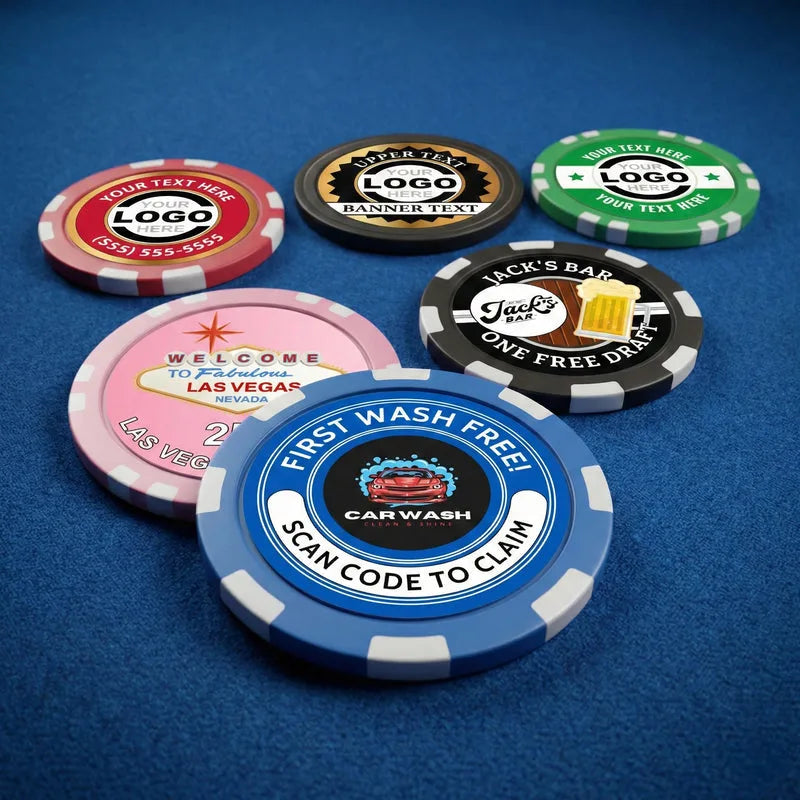
Composite Poker Chips
The biggest print area we offer. Built for logos, photos and QR codes.
from $1.11 · 25 chips · $27.75
Shop composite chips
Compare materials
Composite chips are the best value for most uses, even most poker games. Clay chips are softer, stack a little better, and can be better for tournament play. Pick composite if the artwork comes first: promos, events, weddings, or a home game where you want the biggest canvas. Pick clay if the table comes first: casino weight, softer feel, multi-color edges. Both stack flat and play well; the rest is the same shop, the same printing, the same 25-chip minimum.
The biggest print area we offer. Built for logos, photos and QR codes.
from $1.11 · 25 chips · $27.75
Shop composite chips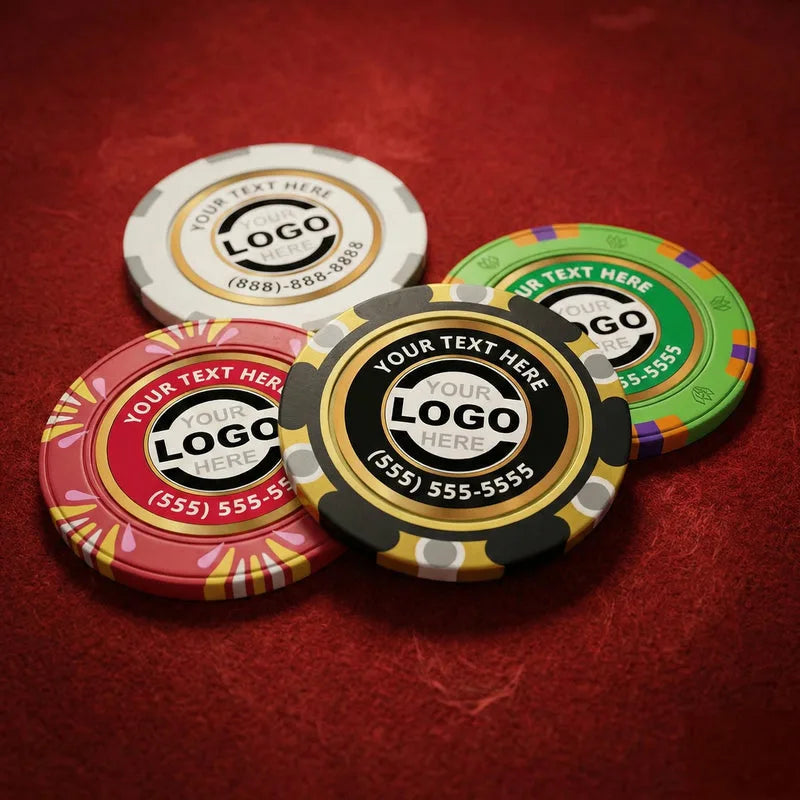
Casino weight, multi-color edges. Built for the table.
from $1.28 · 25 chips · $32.00
Shop clay chips| Composite | Clay | |
|---|---|---|
| Best for | Promos, events, weddings, home games where artwork comes first | Leagues, tournaments, casino-feel sets |
| Weight | 11.5g | 13.5g casino weight |
| Feel | Smooth, hard face, crisp click; a good home-game chip | Softer, denser, slightly chalky; the casino-chip feel |
| Print area | 32mm, 80% of the face; the largest we offer | 27mm, about 67% of the face |
| Edge & colors | White edge spots (or solid) · 5 edge patterns · 10 body colors | Multi-color edge spots, 3–4 tones · 4 molds · 9 body colors |
| Construction | Injection-molded premium resin around a metal slug, then trimmed to final size | Polypropylene + barium-sulfate blend, then trimmed to final size |
| Stacking | Clean stacks of 25+ | Clean stacks of 35+; the casino-chip riffle |
| Price | From $1.11 · 25 chips $27.75 | From $1.28 · 25 chips $32.00 |
Same on both: 40mm diameter · Printed both sides · UV sealed · Trimmed to final size · 25-chip minimum · Free online proof · Printed in Colorado. The choice is about feel and print area, not quality or turnaround.
Our composite chips are injection-molded from premium resins around a metal slug, then printed directly on the face. They’re made to tighter tolerances and with better materials than mass-market composite chips, and like every chip we make they’re finished after molding rather than left as-molded.
Every chip we make, composite or clay, is trimmed to its final size in a dedicated machine. That’s why our chips are dimensionally identical from the first chip to the ten-thousandth, and why they don’t warp the way compression-molded chips can. Composite makes a genuinely good poker chip for it: flat, identical, a clean stack. Clay just goes a step further on weight and feel.
The hard, smooth face is also what makes composite the best printing surface we have: a 32mm print area, 80% of the chip, that holds small type, photos and QR codes cleanly.
“Clay” is a bit of a misnomer across the whole industry; almost no modern poker chip is made from actual clay. Ours are a blend of polypropylene and barium sulfate, with additives that help the printing ink bond to the surface. The barium sulfate is a mineral filler; it’s what gives the chip its 13.5g weight and that slightly chalky, textured feel players love. (It’s also completely safe; it’s used in medicine as an X-ray contrast agent.)
These are not compression-molded clay chips. True compression clays (Paulson, ASM) are made by pressing a proprietary mineral-and-resin blend in heated molds, and many enthusiasts consider them the gold standard. They also cost more than four times as much. Our clay chips are molded with a flat face and trimmed to exactly 40mm like every chip we make; we refurbish the molds every million chips to keep them that way, and the multi-color edge spots make denominations readable at a glance.
The molded rim and edge spots take up more of the face, so the print area is 27mm, about 67% of the chip. Plenty for a logo and a denomination; tighter for photos and very small type.
Yes. Both are 40mm in diameter, so they fit the same cases, racks and set builder. Clay chips are 2 grams heavier, and a 43mm oversized clay chip is also available.
Because the two feel and stack differently, we recommend picking one material for anything people will play with. Mixing them in one set works, but you’ll feel the difference in the stack.
Absolutely. Most home games run on composite. Ours are 11.5g, trimmed to identical size, and stack flat. Clay is 2 grams heavier with a softer face and multi-color edge spots; that’s the difference you feel in a riffle and see across the table.
If you’ve played in a card room and want that feel, go clay. If you want great-looking chips that play well, composite is the value pick.
Composite chips are printed across a flat 32mm face, 80% of the chip. Clay chips are molded with a rim of multi-color edge spots that take up more of the face, so the printable inlay is 27mm, about 67% of the chip.
For most logos and denominations it doesn’t matter. It matters for QR codes (aim for at least 0.8 inches square; that fits either chip but fills most of a clay inlay), for photos, and for very small type.
The chip bodies and edge spots come in fixed combinations; we mold the blanks in large batches a few times a year, which is what keeps costs down and turnaround fast. Composite chips always have white edge spots (or none, on the Solid pattern); clay chips have colored spots that vary by mold. Everything inside the center circle is yours to design.
Yes. Every chip, composite or clay, is printed direct-to-chip and sealed with a UV coating, so the artwork is part of the chip rather than a sticker on top of it.
It is. The chalky look comes from the micro-texture of the barium-sulfate blend, and it’s part of why the chips feel the way they do. If you’d rather have richer color, a light coat of mineral oil rubbed in with a soft cloth and buffed off fills in that texture and deepens the colors. Mineral oil is chemically inert with polypropylene, so it won’t degrade or warp the chip.
If you’re unsure, order the $1 sample pack; it has one of every style we print, so you can hold both. Failing that: if the artwork comes first, composite; it plays well too. If the feel in your hand comes first, clay.
The $1 sample pack has 7 real chips on a card, one of every style we print, so you can feel the difference yourself.
Get Sample Pack for $1Ask us